End The Syndemic TN
HIV stands for human immunodeficiency virus. HIV weakens a person’s immune system by destroying important cells that fight off infections. Our immune plays an important role in protecting us from pathogens like bacteria, viruses, and fungi and untreated HIV can reduce the ability of the body to fight off these infections.
There is currently no curet for HIV, but treatment for HIV is very effective. With treatment a person can live a long healthy life.
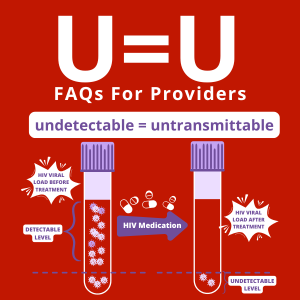
HIV treatment is so effective that it can reduce the amount of HIV virus in a person’s body to an undetectable level. Someone with a undetectable level of HIV in their body (also called an undetectable viral load) cannot pass HIV on to their partner(s). This is called U=U or undetectable = untransmittable and it is 100% effective in preventing the sexual transmission of HIV and also helps to prevent passing HIV from sharing syringes, childbirth, and breastfeeding.
Getting tested is the first step!

Learn More About HIV
HIV Fast Facts
HIV (human immunodeficiency virus) is a virus that attacks the body’s immune system. Without treatment it can lead to AIDS (acquired immunodeficiency syndrome) also called stage 3 HIV which can be life threatening.
HIV can affect anyone who has unprotected sex, regardless of gender or sexual orientation.
The only way to know your HIV status is to get tested. There are many options for quick, free, and painless HIV testing. Health departments can confidentially test you and your partner(s) any time for HIV. If your test result is positive, there are safe and effective treatments to help you live a long, healthy life, and protect others. If your test result is negative, there are prevention options to prevent getting HIV.
The CDC recommends that everyone between the ages of 13 and 64 get tested for HIV at least once. People who might have ongoing vulnerability should get tested more often.
Most people have flu-like symptoms within 2-4 weeks after getting HIV and those symptoms can last for a few days or several weeks. Some people have no symptoms at all. The only way to know if you have HIV is to get tested.
Most people who get HIV get it from anal or vaginal sex, sharing needles, syringes, or other items used to inject drugs. HIV is spread through blood, semen, pre-seminal fluid, rectal fluids, vaginal fluids, and breast milk.
Yes! There are many effective tools to prevent HIV and many can be combined.
*It’s important to note that people who are living with HIV that are on effective treatment and have a sustained undetectable viral load cannot pass HIV to overs through sex. See more about this in the U=U section.
HIV is treated with ART (antiretroviral therapy). ART is safe and effective and should be taken as soon as possible after an HIV diagnosis. HIV treatment reduces the amount of HIV virus int he blood (viral load). HIV treatment can make the viral load so low that a lab test cannot detect it. This is called an undetectable viral load. Having an undetectable viral load (or staying virally suppressed) is the best thing a person living with HIV can do to stay healthy. It also means that person cannot pass HIV through sex to others (U=U).
U=U means undetectable equals untransmittable. It means that a person with a undetectable viral load cannot pass HIV to others through sex. Having an undetectable viral load also reduces the risk of HIV transmission through sharing drug injection equipment and during pregnancy, labor and delivery.
When people get HIV and are not in treatment, for whatever reason, they typically progress through three disease stages. HIV treatment can slow down and even prevent this progression which is why Stage 3 (AIDS) is far less common today.
Stage 1: Acute HIV
Stage 2: Asymptomatic HIV (also called Chronic HIV or clinical latency)
Stage 3: Acquired Immunodeficiency Syndrome (AIDS)
Everybody between the ages of 13 and 64 should be tested for HIV at least once in their life. Others should be tested more often.
Locate testing services near you!
Preventing HIV with Prep
Pre-Exposure Prophylaxis or PrEP is medicine (pills or shots) that reduces your chance of getting HIV.
PrEP can prevent HIV for people that might be exposed to HIV through sex or injection drug use.
PrEP can be an option to help protect pregnant women and their babies from getting HIV while trying to get pregnant, during pregnancy, or while breastfeeding.
Health care providers can help you determine if PrEP is right for you and prescribe the medication.
There are several different FDA approved options for PrEP.
There are two FDA-approved daily oral medications for PrEP. There are also two FDA-approved long-acting injectable forms of PrEP, one that is administered every other month and the other is administered twice yearly.
Some people take PrEP pills only when they have a high chance of getting HIV. This is known as “on-demand” PrEP. While this method of taking PrEP has not been FDA approved, there is scientific evidence that the “2-1-1” schedule provides effective protection for gay and bisexual men when having anal sex without a condom. “On-demand” PrEP involves taking 2 pills 2-24 hours before sex, 1 pill 24 hours after the first dose, and 1 pill 24 hours after the second dose.

PrEP reduces the risk of getting HIV from sex by about 99% when taken as prescribed. Among people who inject drugs, it reduces the risk by at least 74% when taken as prescribed.
Depending on the type of PrEP medication you decide on and they type of sex or drug use practices you have PrEP can take a different amount of time to reach maximum protection. For example, PrEP pills reach maximum protection from HIV at about 7 days of daily use for receptive anal sex (bottoming) but take 21 days of daily use to reach maximum protection for receptive vaginal sex and injection drug use.
Talk to your health care provider about when you will reach maximum protection for your medication and your situation.
There are so many reasons to choose PrEP as an HIV prevention method. Below are just a few reasons why people choose PrEP.
PrEP is for individuals who do not have HIV that are sexually active currently, want to be sexually active in the near future, or inject drugs that want HIV protection.
PrEP should be prescribed to anyone that asks for it regardless of their sexual preferences or drug use history.
PrEP can benefit …
Yes, in most cases, the cost of PrEP medication and services need to get on and stay on PrEP are covered by health insurance plans, Medicaid, and Medicare with no out-of-pocket costs.
Under the Affordable Care Act, PrEP is free under almost all health insurance plans. PrEP is a preventive service and should be covered without charging you a co-payment or co-insurance. This is true even if you haven’t met your yearly deductible.
Services that are covered with no out-of-pocket costs include your PrEP medication, visits to see your PrEP health care provider, and the lab tests you need to get and maintain your prescription.
There are a lot of resources to help people with different circumstances cover the cost of PrEP.
If you have private health insurance that doesn’t cover PrEP or still requires a co-payment but you can’t afford it, you may be eligible to receive co-pay assistance from:
If you do not have health insurance, you may be eligible to receive PrEP medication for free from:
Preventing HIV with Prep
Pre-Exposure Prophylaxis or PrEP is medicine (pills or shots) that reduces your chance of getting HIV.
PrEP can prevent HIV for people that might be exposed to HIV through sex or injection drug use.
PrEP can be an option to help protect pregnant women and their babies from getting HIV while trying to get pregnant, during pregnancy, or while breastfeeding.
Health care providers can help you determine if PrEP is right for you and prescribe the medication.
There are several different FDA approved options for PrEP.
There are two FDA-approved daily oral medications for PrEP. There are also two FDA-approved long-acting injectable forms of PrEP, one that is administered every other month and the other is administered twice yearly.
Some people take PrEP pills only when they have a high chance of getting HIV. This is known as “on-demand” PrEP. While this method of taking PrEP has not been FDA approved, there is scientific evidence that the “2-1-1” schedule provides effective protection for gay and bisexual men when having anal sex without a condom. “On-demand” PrEP involves taking 2 pills 2-24 hours before sex, 1 pill 24 hours after the first dose, and 1 pill 24 hours after the second dose.
PrEP reduces the risk of getting HIV from sex by about 99% when taken as prescribed. Among people who inject drugs, it reduces the risk by at least 74% when taken as prescribed.
Depending on the type of PrEP medication you decide on and they type of sex or drug use practices you have PrEP can take a different amount of time to reach maximum protection. For example, PrEP pills reach maximum protection from HIV at about 7 days of daily use for receptive anal sex (bottoming) but take 21 days of daily use to reach maximum protection for receptive vaginal sex and injection drug use.
Talk to your health care provider about when you will reach maximum protection for your medication and your situation.
There are so many reasons to choose PrEP as an HIV prevention method. Below are just a few reasons why people choose PrEP.
PrEP is for individuals who do not have HIV that are sexually active currently, want to be sexually active in the near future, or inject drugs that want HIV protection.
PrEP should be prescribed to anyone that asks for it regardless of their sexual preferences or drug use history.
PrEP can benefit …
Yes, in most cases, the cost of PrEP medication and services need to get on and stay on PrEP are covered by health insurance plans, Medicaid, and Medicare with no out-of-pocket costs.
Under the Affordable Care Act, PrEP is free under almost all health insurance plans. PrEP is a preventive service and should be covered without charging you a co-payment or co-insurance. This is true even if you haven’t met your yearly deductible.
Services that are covered with no out-of-pocket costs include your PrEP medication, visits to see your PrEP health care provider, and the lab tests you need to get and maintain your prescription.
There are a lot of resources to help people with different circumstances cover the cost of PrEP.
If you have private health insurance that doesn’t cover PrEP or still requires a co-payment but you can’t afford it, you may be eligible to receive co-pay assistance from:
If you do not have health insurance, you may be eligible to receive PrEP medication for free from:
Undetectable = Untransmittable
The “U=U” campaign promotes the message that individuals living with HIV who take medication to achieve and maintain an undetectable viral load cannot transmit the virus to their sexual partner(s). This message is vital to combating HIV-related stigma and empowering people to enter and remain engaged in HIV care.
HIV viral load tests measure the amount of HIV virus in the blood. There are many different viral load tests used by labs in the United States, each with different degrees of sensitivity for detecting the HIV virus. Some viral load tests are very sensitive and can measure as few as 20 copies of the HIV virus per milliliter (mL) of blood, while other viral load tests need at least 200 copies per/mL to detect the HIV virus. If there are less than the number of copies able to be detected by that lab test, the number of viral particles in the blood are said to be “undetectable”.
Regardless of the which test is used, if someone’s HIV viral load remains below 200 copies/mL of blood they are considered undetectable. Undetectable means the same thing as being virally suppressed.
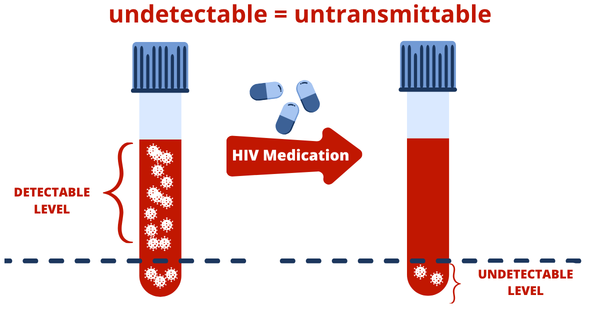
Untransmittable means there is no evidence that individuals who have successfully achieved and maintained an undetectable viral load through antiretroviral therapy (ART) can transmit the virus through sex.
Once the provider finds the right ART regimen for a person it can take up to 6 months for the medications to lower the number of HIV viral particles in a person’s body to an undetectable level. Taking medications as prescribed and remaining in HIV care helps people get to an undetectable level faster. Getting viral load labs is the only way to know when a person has reached an undetectable level.
Every person’s body is different. It may take a provider some time to find the right medications for a person living with HIV and some more time for the medications to work at their best level in person’s body. It is important not to compare the time it takes one to become undetectable to other people living with HIV. Remaining in HIV care is the best way to reach and keep and undetectable status.
After first reaching an undetectable viral load, it is recommended a person living with HIV should maintain viral suppression for 6 months before they use their undetectable status as a method of HIV prevention.
Viral load testing is how a provider and person living with HIV knows their HIV medications are working. It is also the only way to ensure a person living with HIV has kept their undetectable status and can keep using it as a method of HIV prevention.
A person living with HIV should get viral load testing every three months to make sure they are virally suppressed. If a person has been undetectable for a long time a provider may switch to less frequent viral load testing like every 6 months.
Yes. People living with HIV that have an undetectable viral load cannot transmit HIV through insertive or receptive vaginal, anal, or oral sex.
Since U=U only applies to HIV and does not protect individuals from other STIs and unwanted pregnancy, condoms are important option to prevent STIs and unwanted pregnancy.
Like U=U, PrEP is an effective HIV prevention tool. This once-a-day pill is estimated to be more than 99% effective in preventing sexual transmission of HIV. U=U is estimated to be 100% effective in preventing the sexual transmission of HIV.
While taking PrEP may not be necessary if a person is in a monogamous relationship with someone who has an undetectable viral load, a partner may still want to take PrEP because they feel more assured by making their own sexual health choice or have additional partners.
HIV stigma has kept many people living with HIV out of care and has prevented other people from even wanting to get tested for HIV. To end the HIV epidemic in the United States we need every person to know their HIV status and for all people living with HIV to become and remain engaged in care. Talking about U=U reduces stigma about HIV. U=U encourages people to know their HIV status by getting tested. And for those living with HIV, U=U helps motivate people to stay in care. U=U is a message of hope that all people (those living with HIV and those not living with HIV) can live and love without fear thanks to truly effective HIV medications.
How a person talks about U=U is very important to people understanding the message and feeling confident that U=U is an effective HIV prevention method. The most important part is be clear that U=U works and to talk about it often. Below is some language guidance to consider when talking about U=U.
Try these phrases, which are clear and accurate | Instead of these phrases , which may cause doubt |
|---|---|
People who are undetectable do not
transmit HIV.
| People who are undetectable are extremely unlikely to transmit HIV. |
There is no risk that a person with an undetectable viral load will pass HIV to a partner. | There is less risk that a person with an unpredictable viral load will pass HIV to a parnter. |
test2 | test2 |
There is a lot of scientific research and evidence that supports U=U. Some of the most important studies are summarized below. The CDC says U=U is 100% effective.
Click here to read CDC’s estimated effectiveness of various HIV prevention methods.
Study Name | Number of Couples in the Study where one partner was living with HIV and one was not | Number of Condomless Sex Acts | Number of Instances HIV was Passed from an Undetectable Partner to a Partner Not Living with HIV |
|---|---|---|---|
People who are undetectable do not
transmit HIV.
| People who are undetectable are extremely unlikely to transmit HIV. | People who are undetectable are extremely unlikely to transmit HIV. | People who are undetectable are extremely unlikely to transmit HIV. |
There is no risk that a person with an undetectable viral load will pass HIV to a partner. | There is no risk that a person with an undetectable viral load will pass HIV to a partner. | There is no risk that a person with an undetectable viral load will pass HIV to a partner. | There is less risk that a person with an unpredictable viral load will pass HIV to a parnter. |
test2 | test2 | test2 | test2 |
test | test | test | test |
The mission of the Tennessee Ryan White Part B Program is to promote health and access to quality care for Tennesseans living with HIV/AIDS. The Ryan White Part B Program provides HIV/AIDS primary medical care, essential support services, and medications for eligible residents. Through successful case management people living with HIV/AIDS are empowered to effectively manage their HIV/AIDS and improve their overall health and quality of life.
Find HIV Testing, Prevention, and Treatment Services Near You
The tool takes advantage of open data from HHS agencies such as CDC, SAMHSA and HRSA, along with other Federal departments like HUD, to allow searches across many service provider databases at one time. Results are displayed on a dynamic map, marking each service provider near the location you searched. You can view the provider’s contact information, which services they provide, and get directions to the provider’s location.
HIV Education Resources
Below are free downloadable HIV education materials designed to share practical information, strengthen health education, and support conversations about HIV testing, prevention, and treatment. Materials may be downloaded, printed, and shared to help expand access to clear, supportive, and evidence-based HIV information across Tennessee.
HIV Community Planning in Tennessee
HIV community planning in Tennessee is based on a grassroots system that empowers local, community-based stakeholders to guide how state and federal dollars are spent and to shape emerging state prevention efforts.
Each of the six regions across the state has a Community Planning Group (CPG). These groups meet regularly within their communities and have standing by-laws and operating procedures. These groups inform HIV Prevention and Ryan White (Parts A and B) efforts in their regions.
TN CHAPs
Southwest: The HIV Care and Planning Group (or HCAP). Learn more about HCAP here. Click here to email the Planning Council Manager for the Shelby County Ryan White Part A Program.
West: The West Tennessee HIV/AIDS Partnership (or West TN CHAP). Learn more about West TN CHAP.
Middle: The Middle Tennessee HIV/AIDS Partnership (or Middle TN CHAP). Learn more about Middle TN CHAP.
Nashville: The Nashville Transitional Grant Area Ryan White Part A Planning Council. Click here to learn more about the Nashville Part A Planning Council.
Southeast: The Southeast Tennessee HIV/AIDS Partnership (or Southeast TN CHAP). Learn more about Southeast TN CHAP.
East: The East Tennessee HIV/AIDS Partnership (or East TN CHAP). Learn more about East TN CHAP.
Please allow 2-3 business days for a response.
Ryan White Part B Program: TN.RWPB@tn.gov